01
Start from the real setting
Interviews and on-site observation help us share the preschool's goals, challenges and current situation.
Introducing the Yuria Method is not a training course that ends when the session is over. We begin with interviews and on-site observation, then move through foundations, practice, application, environmental planning and a final review. We work with the everyday life of your preschool to move from practice that makes children comply to practice that supports their development and agency.
From preparation to certification and publication
Support over a period of up to approximately six months
Maximum total guideline for the introduction package
Certification after implementation and review
The first step is not a lecture. It is a conversation and on-site observation. We clarify goals and plans while looking closely at the children, the educators, the classroom environment and the local context of the preschool.
From there, we move into foundation and practice modules, develop an environmental plan, discuss it as a team, and decide what the preschool will actually change.
Interviews and on-site observation help us share the preschool's goals, challenges and current situation.
Two foundation modules and three practice modules build a shared understanding among staff.
Create an environmental plan, discuss it together and decide what the preschool will put into practice.
Questions, reflection and the final review help the team examine everyday practice and move toward certification.
Depending on the preschool, we move through preparation → foundations → practice → application → certification and publication, going back and forth between learning and everyday implementation.
The introduction package places preparation, foundations, practice, application and certification across months 1–6. Meetings, training, planning, team discussion, Q&A, interviews, on-site observation and review total up to approximately 30 hours as a guideline.
Timing and content are adjusted to each preschool. E-Learning is currently in preparation.
Implementation support does not impose a single way of working from outside. We examine the preschool's taken-for-granted routines together and ask whether “getting things done” has become the goal. The starting point is the child's actual experience.
Grounded in children's rights, we bring four lenses—development, environment, teamwork and education—into specific everyday situations.
Understand the content and sequence of development, and look at where the child is now and what they may be moving toward next.
Shape space, time, materials and daily flow so children can engage their own capacities for development.
Do not leave responsibility with one educator. Share observations and support development across the classroom and preschool.
See HOIKU not as simple supervision, but as an integrated practice of care and education in which learning is present in everyday life and play.
Quality does not appear only in special activities. It appears in how long adults wait, how mistakes are handled, how language is chosen and how the environment is arranged. Teams keep asking whether children can act with agency, whether relationships between children can emerge, and whether adults are stepping forward too quickly.
Look beyond whether a child succeeded or failed and consider the intention and developmental meaning behind the action.
Observation is not inaction. The team considers how to avoid unnecessary intervention while providing support at the right time.
Move beyond individual experience or intuition and share practice through the lenses of development, environment, teamwork and education.
“Observe first,” “shape the environment around development,” and “support children as a team.” Two preschools describe how the learning translated into everyday practice.
“It gave me the opportunity to return to what it really means to value each child, and to look again at my own practice.”
The team began looking more closely at everyday routines and creating the environment through conversation with colleagues and children.
Even though I already wanted to value each child, I realized there were ways to look much more deeply at the individual. With younger children, we reconsidered everyday moments such as meals, toileting and sleep.
We started listening more closely to children's ideas and changing the environment through discussion among the teaching team.
I became more intentional about seeing each child carefully. Their ideas and daily changes reminded me again of what makes early childhood work so rewarding.

“We took a particularly close look at how our staff work together.”
Ms. Ikeda explains that introducing the Yuria Method gave the team an opportunity to share their different views of childcare, deepen their understanding of child development, and think together about how to put that understanding into practice. She describes concrete changes in staff coordination, daily routines around meals, toileting and sleep, and their gradual approach to mixed-age experiences.
It gave us an opportunity to share each staff member's views of childcare while deepening our understanding of child development, so that we could think together about how to provide careful, individualized care for each child and then put those ideas into practice.
We reviewed the environment as well, but we focused particularly on staff coordination. We want the same rhythm of daily life to be maintained so that children can feel secure no matter which staff member is with them, and we place importance on listening to the voice of each individual child.
We are finding ways to coordinate among staff throughout the sequence of meals, toileting and sleep. Even during toileting, we make sure there is time for communication between the educator and the child so that the child can move toward sleep feeling secure. In particular, the staff member responsible for meals consciously adjusts the timing of when children are guided to toileting, helping the overall flow of time feel more relaxed.
A classroom teacher suggested mixed-age activities, so we began trying to create more time for the zero- and one-year-old children to spend together. At first, the one-year-olds were still exploring how to interact and the zero-year-olds sometimes became uneasy, so there was not enough room for everyone to fully enjoy the activity. We are now proceeding gradually, starting with short periods after nap time.
Our next challenge is to create an environment in which children of different ages naturally enjoy being together and imitate one another.
Many staff members, including the lead teacher and classroom teachers, took part in the training together. As the training progressed step by step, our sense of unity grew and we were able to establish a shared foundation for improving our own classrooms.
One thing that was especially memorable was the way Jack asked questions of the whole staff, creating time for us to share views of childcare that we had not known about one another. As staff members actively considered questions and engaged in dialogue, we were able to rediscover the enjoyment of childcare itself.
We also create opportunities to share the Yuria Method with staff members who could not attend the training. By explaining and communicating what they learned, staff members are deepening their own understanding as well.
After completing the introduction process and passing the final review, the preschool is certified as a Yuria Method Certified Preschool.
Certified preschools are listed on the Certified Preschools page of the Association website. Their name and location are introduced as preschools practicing the Yuria Method.
After certification, the preschool receives a certificate and Certified Preschool plaque. A certification review and certification training are then conducted every three years so the team can continue reflecting on everyday practice.
Our aim is for this plaque to become a familiar sign that families look for when choosing a preschool.
View current Certified Preschools →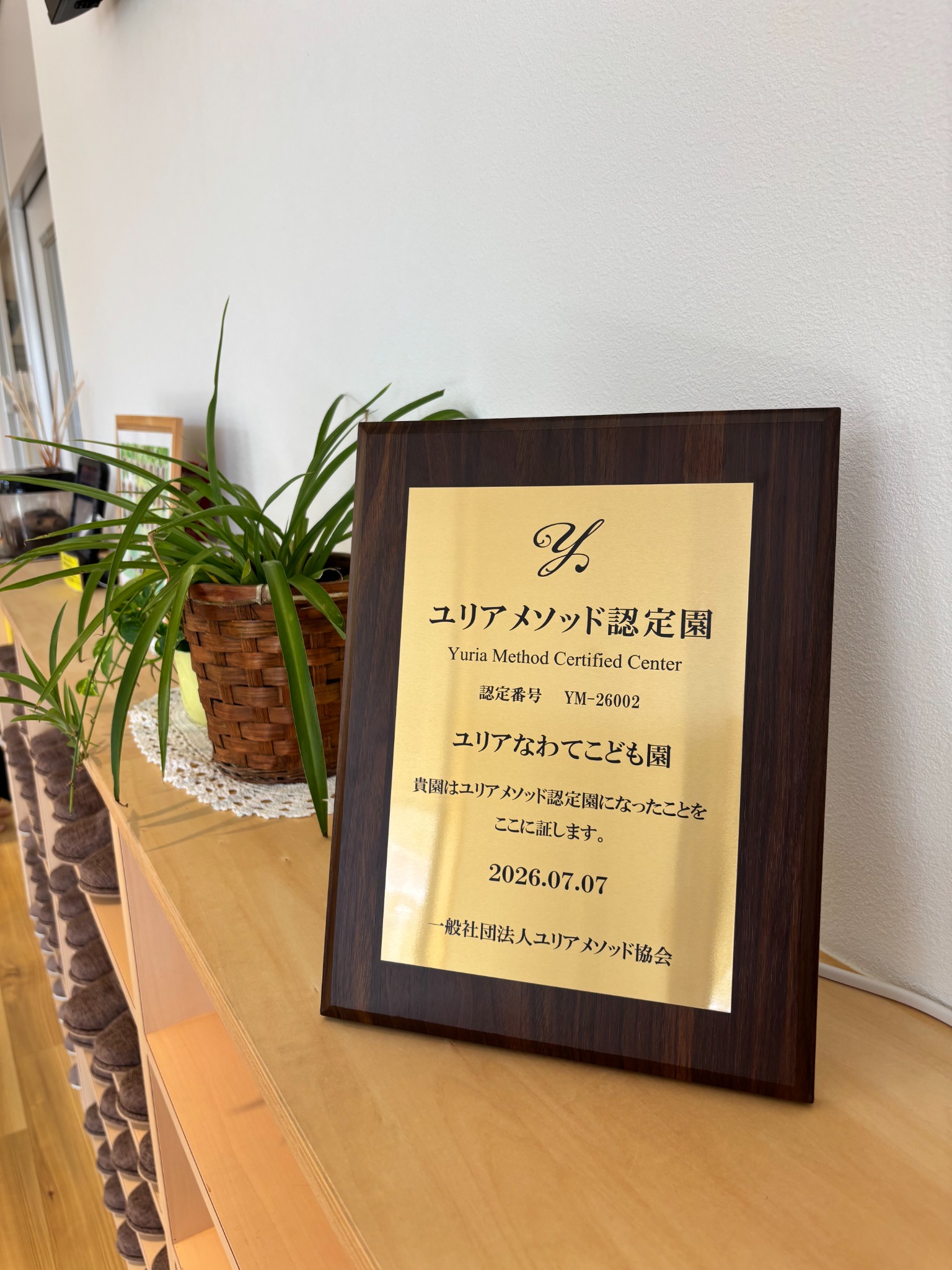
Training, environmental design and everyday practice.
Review the introduction process against the certification criteria.
After passing, the preschool is certified and listed on the website.
Shared understanding and stronger communication can help create a workplace where staff can ask for help and are less likely to carry concerns alone. Effects on retention or workplace satisfaction vary by context.
Support over a period of up to approximately six months.
From initial consultation through training, implementation support and reflection.
Preschool membership is JPY 20,000 per year + tax. Because the member rate for introduction support is substantially lower, we recommend reviewing the Preschool Membership option as well.
See Preschool Membership benefits →Tell us about your current practice, the challenges you are facing and what you hope to change. We will explain how the Yuria Method introduction process could support your team.
Please write “Yuria Method introduction” at the beginning of your inquiry.